
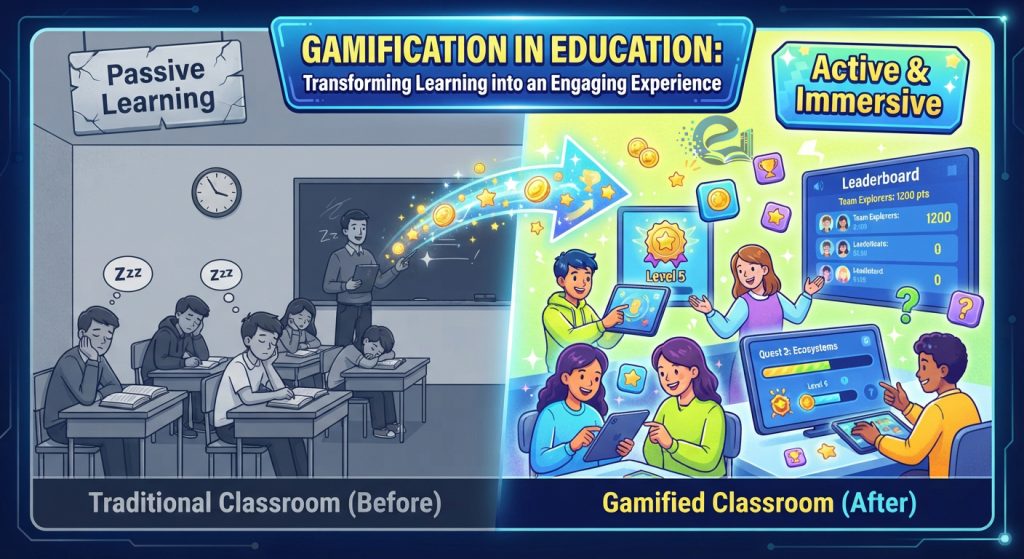
Remember the last time you lost track of hours playing a video game? You were challenged, failing safely, learning the mechanics, and constantly rewarded for your progress. Now, imagine bringing that exact level of engagement into the classroom.
Welcome to the world of gamification in education—the strategic use of game design elements in non-game contexts to turn traditional learning into an immersive adventure.
Why Traditional Teaching Needs an Upgrade
For decades, the standard educational model has relied heavily on passive listening, rote memorization, and high-stakes testing. While effective for some, this approach often leaves students feeling disengaged, anxious, or bored.
Gamification flips the script. Instead of punishing failure, it treats mistakes as stepping stones to mastery. By tapping into core human motivators—like achievement, competition, and curiosity—educators can bridge the gap between “have-to-learn” and “want-to-learn.”
Core Game Mechanics Used in the Classroom
Integrating games into education isn’t just about playing video games in class; as noted in foundational literature, it is about borrowing the psychological building blocks that make games effective outside entertainment contexts (Deterding et al., 2011; Kapp, 2012):
- Points and Scoring: Immediate numerical feedback lets students track their exact progress and see growth instantly.
- Badges and Achievements: Visual tokens of accomplishment that celebrate milestones, from mastering multiplication to maintaining a week-long homework streak.
- Leaderboards: Friendly competition that encourages students to push their boundaries (best used carefully to foster collaboration rather than anxiety).
- Quests and Levels: Breaking down an intimidating semester-long syllabus into bite-ized missions and progressive stages.
- Instant Feedback Loops: Allowing students to try, fail, adjust, and try again within seconds, preventing frustration.
What the Data and Research Say
Gamification is far more than a passing classroom gimmick; it is backed by a growing body of empirical research and market analytics:
- Boosted Engagement: Broad literature reviews on empirical studies confirm that gamification reliably improves user participation, motivation, and task execution (Hamari, Koivisto, & Sarsa, 2014).
- Targeted Psychological Impact: Research into higher education shows that specific game elements like badges, leaderboards, and avatars directly fulfill psychological needs for competence and autonomy, driving deeper learning motivation (Sailer et al., 2017).
- Rapid Industry Growth: Driven by mobile learning adoption, digital classrooms, and the demand for experiential learning, the global gamification in education market continues a rapid multi-billion dollar expansion path (Market Data Forecast).
- Enhanced Skill Acquisition: Immersive learning studies by organizations like PwC demonstrate that interactive and gamified environments drastically cut training time and build higher user confidence compared to standard lecture formats.
The Transformative Benefits of Gamified Learning
When implemented thoughtfully, gamification yields powerful results for both students and teachers:
Did You Know? Studies consistently show that gamified learning environments significantly boost student engagement, class attendance, and knowledge retention compared to traditional lecture-only formats.
- Boosts Intrinsic Motivation: External rewards spark initial interest, which often transforms into a genuine love for the subject matter.
- Lowers Test Anxiety: When an assessment is framed as a “boss battle” or a quiz game (like Kahoot or Quizizz), the pressure drops, and cognitive performance improves.
- Teaches Resilience: Games normalize failure. Re-trying a level teaches students that setbacks are simply part of the learning curve.
- Promotes Collaboration: Many educational games require multiplayer teamwork, teaching crucial communication and problem-solving skills.
How to Get Started
You don’t need a massive tech budget or a custom video game to gamify learning. Here are a few simple ways educators are applying these principles today:
- Turn Quizzes into Game Shows: Use digital tools to transform routine reviews into fast-paced trivia challenges.
- Create a Badge Economy: Award digital badges for participation, helping others, or showing creative problem-solving.
- Design a Choose-Your-Own-Adventure Project: Let students pick different “quests” or research paths to reach the same final learning objective.
The Future is Playful
Gamification isn’t a passing fad; it is a fundamental shift in how we view instruction. By meeting students in a language they already speak—play—we can transform classrooms from spaces of obligation into vibrant arenas of discovery.
Recommended Reading & Academic Sources
- Deterding, S., Dixon, D., Khaled, R., & Nacke, L. (2011). “From game design elements to gamefulness: defining ‘gamification’.” Proceedings of the 15th International Academic MindTrek Conference.
- Kapp, K. M. (2012). The Gamification of Learning and Instruction: Game-based Methods and Strategies for Training and Education. Pfeiffer.
- Hamari, J., Koivisto, J., & Sarsa, H. (2014). “Does gamification work? — A literature review of empirical studies on gamification.” Proceedings of the 47th Hawaii International Conference on System Sciences.
- Sailer, M., et al. (2017). “Fostering application learning in higher education through gamification: A generalized-experimental approach.” Computers in Human Behavior.
- Market Data Forecast. Global reports tracking the expansion of the Gamification in Education Market.